CRITICAL: Henry Lawson or Banjo Paterson? Explain briefly your understanding of why these two authors were so different in their views of the Australian experience.
It is remarkable how two people talking about the same place at the same time can come to such radically different representations of that place. So it is with Henry Lawson and Banjo Patterson. Welcome to the second blog, in which we diverge from our creative pursuits and conduct a critical analysis of these seminal Australian poets.
Banjo Patterson was staunchly against much of British influences, his first published work a criticism of the British war in Sudan, in which Australian troops were involved. Patterson’s disposition to portray the Bushman as a staunch, heroic underdog appealed greatly in an environment fostering feelings of nationalism that were uniquely Australian in nature and propagating the idea of federation and sovereignty. In the Bushman, they could see Australia leaving behind the influence of its progenitor and forging a bright new path. Patterson was a lawyer and newspaper correspondent who built his career alongside with his work.
On the other hand Lawson was deaf by the age of fourteen courtesy of an ear infection. He spent time as a hand on Toorale Station, a sheep and cattle station in north-western New South Wales. Bruce Elder writes of this experience “it confirmed all his prejudices about the Australian bush. Lawson had no romantic illusions about a ‘rural idyll’.” Whilst he spent most of his life dwelling in the city, he had a fair amount of exposure to the outback. He struggled financially to make ends meet as a poet in the tough, materialistic Australian landscape. In these disparities, we can begin to glimpse some of the motivations for their differences.
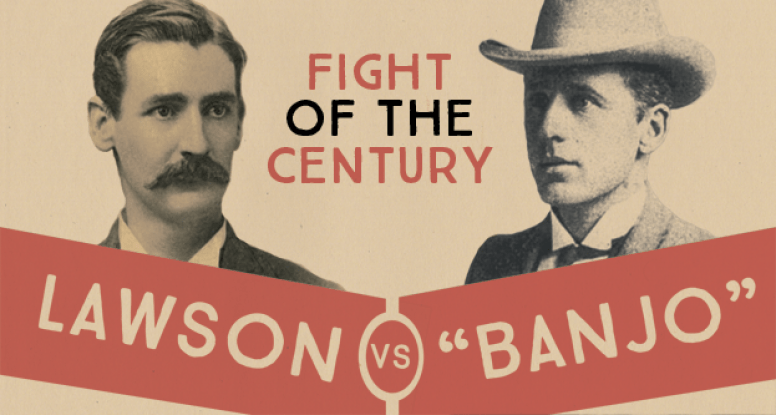
Feels like a boxing match! In many ways it was, for Australia’s perception of itself
These influences and differences were on full display in what has been dubbed “The Bulletin Debate”. In 1892 there was an Australian magazine called the ‘The Bulletin’, which had built up a renown in local circles for budding poets and writers to disperse their works, often as part of a growing trend of nationalism which was termed the “Bulletin School”. Into these pages delved Lawson, with a scathing diatribe against the aggrandised representations of the Bush that frequented the national psyche:
Henry Lawson Up the Country 1892
…I am back from up the country, up the country where I went
Seeking for the Southern poets’ land whereon to pitch my tent;
I have shattered many idols out along the dusty track,
Burnt a lot of fancy verses — and I’m glad that I am back.
I believe the Southern poets’ dream will not be realised
Till the plains are irrigated and the land is humanised.
I intend to stay at present, as I said before, in town
Drinking beer and lemon-squashes, taking baths and cooling down.
We can see Lawson’s use of metaphor and first person conveys his desire to cut through the ‘fancy verses’ of his contemporaries to unveil the true reality of the land in which they dwelt.
Banjo responded with ‘In Defence of the Bush’
Banjo Paterson In Defense of the Bush 1892
…And the ‘shy selector children’ — were they better now or worse
Than the little city urchins who would greet you with a curse?
Is not such a life much better than the squalid street and square
Where the fallen women flaunt it in the fierce electric glare,
Wher the sempstress plies her needle till her eyes are sore and red
In a filthy, dirty attic toiling on for daily bread? …
Banjo’s evocative rhetoric summons to mind a drab urban hellscape, which is sure to give any reader pause. Surely the bush must be better than this?
Here we can see the classic conflict of city and country on full display. What makes this dynamic intriguing is both are residents of the city. One presents it as a haven of civilization amidst the untamed wild, the other a banal urban misery. And when viewed in this lens, it’s as though their role and mindset have suddenly swapped! Banjo is dourly lamenting the surrounding environment whilst Lawson sings its praises. Both demean one environment for the sake of the other.
We have some interesting insight into this debate from Banjo himself in his later years when he did an interview with the Sydney Morning Herald –
Henry Lawson was a man of remarkable insight in some things and of extraordinary simplicity in others. We were both looking for the same reef, if you get what I mean; but I had done my prospecting on horseback with my meals cooked for me, while Lawson has done his prospecting on foot and had had to cook for himself. Nobody realized this better than Lawson; and one day he suggested that we should write against each other, he putting the bush from his point of view, and I putting it from mine.
“We ought to do pretty well out of it,” he said, “we ought to be able to get in three or four sets of verses before they stop us.”
This suited me all right, for we were working on space, and the pay was very small . . . so we slam-banged away at each other for weeks and weeks; not until they stopped us, but until we ran out of material . . .
“Banjo Paterson Tells His Own Story”,
Sydney Morning Herald, 4 Feb-4 Mar 1939
Perhaps a degree of cynical utilisation, but the essence of their debate is one that Australia was grappling heavily with at the time, and indeed arguably still is to this day. It’s fair to say that the more inspiring Banjo’s work stays in the popular conscious, but beneath the veneer lies a most ancient and harsh country that we would do well to pay a hearty volume of respect. Look no further than my first blog to consider that! Who do I side with more? The Drovers Wife and The Man from Snowy River, arguably their most renowned works, are in many ways different faces of the same coin. Looking in opposite directions and never to meet, but fused together by their time and place. In my view, there is plenty of room for both and more in this ‘wide brown land’.
Elder, Bruce (2008), “In Lawson’s tracks [The Henry Lawson Trail from Bourke (NSW) to Hungerford (Qld). Paper in: Re-imagining Australia. Schultz, Julianne (ed.).]”, Griffith Review (19): 95
Henry Lawson Up the Country 1892
Banjo Paterson In Defense of the Bush 1892
“Banjo Paterson Tells His Own Story”,
Sydney Morning Herald, 4 Feb-4 Mar 1939
Bairstow, Amy. “Fight of the Century.” AmyBairstow.com, October 30 2017, http://amybairstow.com.au/banjo-paterson-and-henry-lawson-once-had-a-poetry-slam/
 Andrew Colman: Adventures in Literature
Hi Andrew,
I thoroughly enjoyed reading your critical blog post about the differences in Henry Lawson and Banjo Paterson’s literary works. I agree with you in that it is remarkable how “two people talking about the same place at the same time can come to such radically different representations of that place”. This definitely highlights how although we may be exposed to the same environment, we are all unique human beings and so our interpretations and personal experiences are also unique.
I thought it was clever how you conducted research on their lives before beginning your analysis. This gave me a better understanding as to why they may have written the way they did and instilled in me a greater appreciation for the diversity of human experiences as well as the powerful effect they can have, which we view through their written work.
I especially liked the construction of your sentence, “One presents it as a haven of civilization amidst the untamed wild, the other a banal urban misery”. The direct contrast really puts into perspective the differences in their views regarding their environment.
Your post led me to contemplate on both their work and even allowed me to think about who I would side with more. As I believe there are no limitations in literature, everyone is free to interpret experiences differently.
I look forward to reading more of your work, Great Job!
LikeLike