What touched you most in your visit to the State (Mitchell) Library, the Shakespeare Room and the Shakespeare sculpture today?
The Shakespeare memorial that stands outside the State Library was striking. Risking life and limp, we dashed across the busy highway entry point to the median strip where it stands. Shakespeare stands above several of his seminal characters; Romeo and Juliet, Othello, Portia and Falstaff. We were informed during our seminar that it was commissioned on the impetus of the Shakespeare society.
Our revels now are ended. These our actors,
As I foretold you, were all spirits and
Are melted into air, into thin air:
And, like the baseless fabric of this vision,
The cloud-capp’d towers, the gorgeous palaces,
The solemn temples, the great globe itself,
Yea, all which it inherit, shall dissolve
And, like this insubstantial pageant faded,
Leave not a rack behind. We are such stuff
As dreams are made on, and our little life Is rounded with a sleep.
The Tempest Act IV. Sc. 1
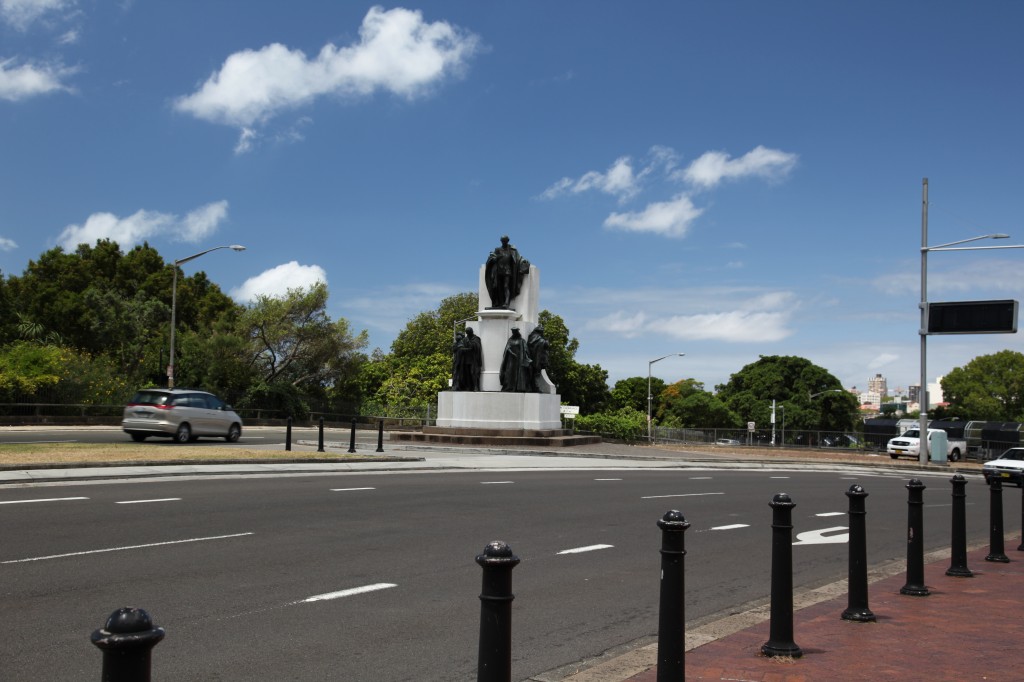
When Michael read aloud this inscription for us, it provoked a sense of curious questioning within me. It was a poignant choice to place upon the memorial. The Tempest being one of Shakespeare’s last plays, it serves in many ways as a retirement speech reflecting upon his time on the stage. It is a metaphor that extends throughout the Tempest to examine the theatre of life. Much as Shakespeare has died, so will we. Yet his thoughts and voice continue far beyond when he is gone, perhaps ours will be the same.
It was thus ironic to note its position in the centre of a highway on ramp amongst slabs of concrete. In the same way as “The cloud-capp’d towers, the gorgeous palaces,” will dissolve, so to will that road and perhaps the statue with it. Yet I am confident the ideas it carries will live on far beyond that time.
IIn much the same vein I took special note of the stained-glass windows in the Shakespeare room itself, located in the Mitchell Wing of the State Library. They depict the seven ages of man, derived from As You Like It.

ALL the world ’s a stage,
As You Like It, Act II. Sc. 7
And all the men and women merely players:
They have their exits and their entrances;
And one man in his time plays many parts,
His Acts being seven ages. At first the Infant,
Mewling and puking in the nurse’s arms.
Then the whining School-boy, with his satchel
And shining morning face, creeping like snail
Unwillingly to school. And then the Lover,
Sighing like furnace, with a woful ballad
Made to his mistress’ eyebrow. Then a Soldier,
Full of strange oaths, and bearded like the pard;
Jealous in honor, sudden and quick in quarrel,
Seeking the bubble reputation
Even in the cannon’s mouth. And then the Justice,
In fair round belly with good capon lined,
With eyes severe, and beard of formal cut,
Full of wise saws and modern instances,—
And so he plays his part. The sixth age shifts
Into the lean and slippered Pantaloon,
With spectacles on nose, and pouch on side;
His youthful hose, well saved, a world too wide
For his shrunk shank; and his big manly voice,
Turning again toward childish treble, pipes
And whistles in his sound. Last scene of all,
That ends this strange eventful history,
Is second childishness and mere oblivion,
Sans teeth, sans eyes, sans taste, sans everything.
It provokes similar reflections on life and our purpose here. Perhaps not answers, but certainly they help provide timely reminders of our mortal coil. Through them I can recognise both life’s great splendour and intensity of purpose and simultaneously its illusion as merely a stage.
 Andrew Colman: Adventures in Literature
