CREATIVE: Take any single Australian painting that you saw at the gallery yesterday (it must be one that you saw) and write a description either in poetry or prose. Pay close attention to detail in your description. What you are in fact doing in this exercise is a piece of Ekphrastic Writing. Check up the meaning of this word!
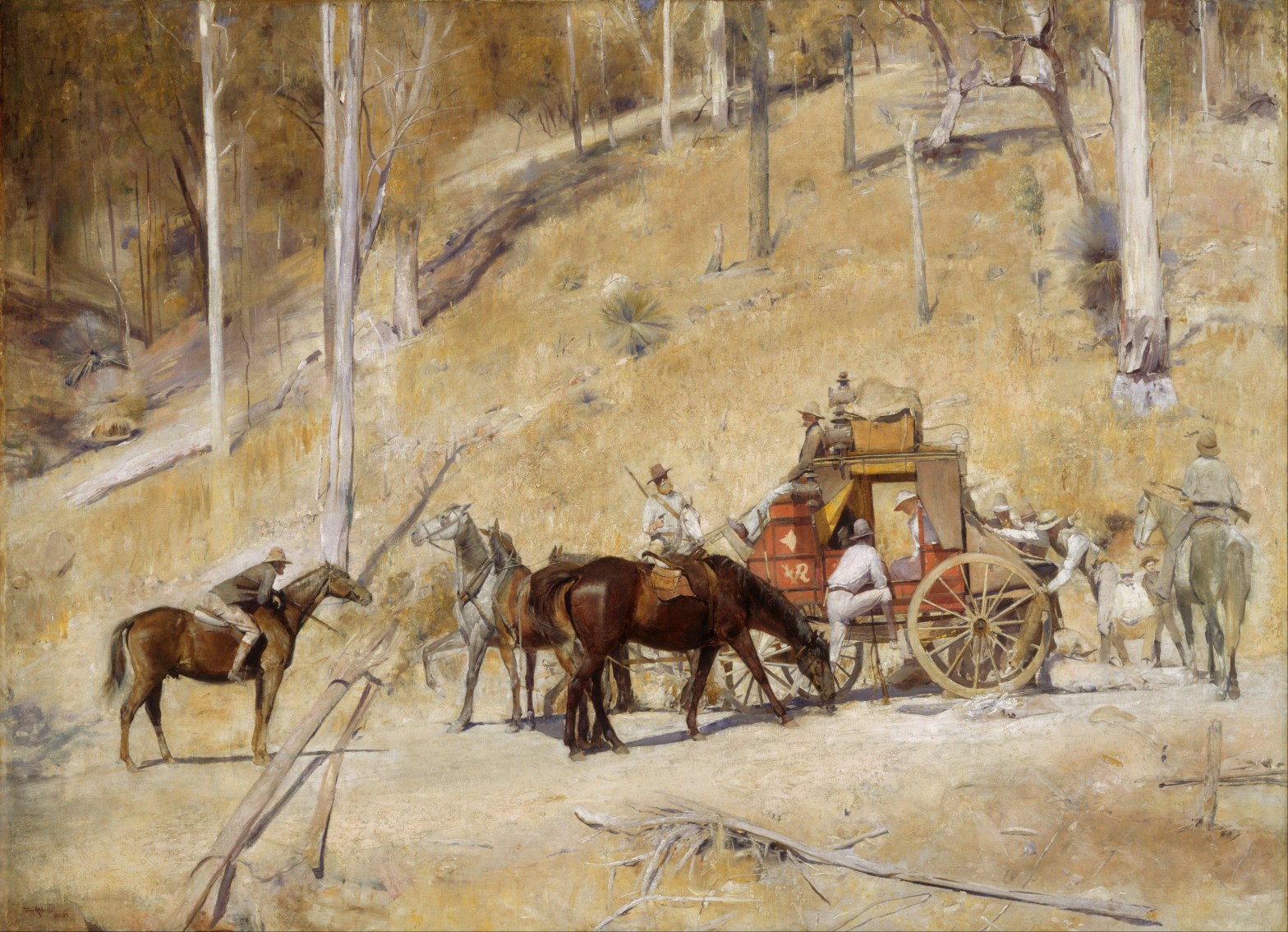
Ekphrastic. Wow, what a wonderful word! Originating from the Greek, it translates to description . Ekphrastic poetry dates all the way back to Homer’s Illiad in his description of Achilles Shield. This is my own humble attempt at such description, to capture the essence behind a visual work and place it in written terms. I was grabbed by Tom Roberts’ Bailed Up in the late colonial era, depicting the holdup of a stage coach. I got a touch of a Robin Hood vibe and doing a little research on the painting I gained some intriguing insights…
‘Bailed Up’ Tom Roberts 1895
Beneath his hat stood proud chiseled features
Hard grey eyes flecked with specks of steel
His hands lovingly caressed his deadly preachers
Terrible blood and thunder they deal
The horses whinnied and snorted
Stamping their feet with eyes ran wild
Around the stage coach they cavorted
As the men atop them smiled
The Driver sighed and surrendered
He was a man well worth his salt
Only too well he remembered
The ways of Captain Thunderbolt
‘Good morning to you Silent Bob’
Came the cheerful calls from below
It was a standard old fashioned job
Disappointing if you hoped for a show
The sun bore brightly down
Upon these noble bush-rangers
In this wide land of brown
As they stood and made polite exchanges
Laconically they worked
Stuffing full their sacks
The tension usurped
For the highwaymen were just another tax
Whilst composing this piece Roberts consulted a man by the name of ‘Silent’ Bob Bates, who was held up by the famous’Captain Thunderbolt’ during the 1860s. For this reason my choice of names was very deliberate for that added contextual detail. Bob gaves to Roberts a detailed description of “the quiet way the whole thing took place”, which we can see translated in the painting. There is no drama in the work according to Humphrey McQueen, the scene lit with bright sunshine, as one of the rangers has a chat with the passenger as he casually leans on the stage coach. “The affray looks like a picnic party delayed by a broken spoke rather than a matter of life or death.”
It exposes a distinctive Australian trait; the carefree, she’ll be right attitude that can be applied to any pressure inducing situation. In a growing national fervor pushing for federation this representation begins to make a lot of sense. I wanted to capture this in the poem with an initial expectation of great drama and tension which can then be shattered by the end of the poem, with the cadence and choice of words.
I’ve enjoyed a lifelong fascination with the history of Egypt, so I can only imagine what having a direct family connection is like. You’ve really captured that idea of history oozing from everywhere you look (if you know to open your eyes and see). It speaks to the greater appeal of stories locked away in historical sites the world over. Some of them we may never know the full story to, yet it this makes them all the more fascinating and appealing. It’s interesting how the sheer passing of time adds to the story of these places, the ‘remnants of the mountain’, even though the original purpose may have been abandoned long ago. We are closer to the birth of Christ than the builders of the pyramids were time wise.
I have a technical suggestion that is more a matter of personal taste than anything else; if the first two lines were in current tense I feel it may help enhance the anticipation and match the pacing of the rest of the work.
‘Magnificent structures awaken, beckoning me to unlock ancient mysteries through the power of my curiosity.’
I gather all the photos at the bottom are from your own travels in Egypt? I am jealous, I hope to do the same one day in the future.
CRITICAL: Henry Lawson or Banjo Paterson? Explain briefly your understanding of why these two authors were so different in their views of the Australian experience.
It is remarkable how two people talking about the same place at the same time can come to such radically different representations of that place. So it is with Henry Lawson and Banjo Patterson. Welcome to the second blog, in which we diverge from our creative pursuits and conduct a critical analysis of these seminal Australian poets.
Banjo Patterson was staunchly against much of British influences, his first published work a criticism of the British war in Sudan, in which Australian troops were involved. Patterson’s disposition to portray the Bushman as a staunch, heroic underdog appealed greatly in an environment fostering feelings of nationalism that were uniquely Australian in nature and propagating the idea of federation and sovereignty. In the Bushman, they could see Australia leaving behind the influence of its progenitor and forging a bright new path. Patterson was a lawyer and newspaper correspondent who built his career alongside with his work.
On the other hand Lawson was deaf by the age of fourteen courtesy of an ear infection. He spent time as a hand on Toorale Station, a sheep and cattle station in north-western New South Wales. Bruce Elder writes of this experience “it confirmed all his prejudices about the Australian bush. Lawson had no romantic illusions about a ‘rural idyll’.” Whilst he spent most of his life dwelling in the city, he had a fair amount of exposure to the outback. He struggled financially to make ends meet as a poet in the tough, materialistic Australian landscape. In these disparities, we can begin to glimpse some of the motivations for their differences.
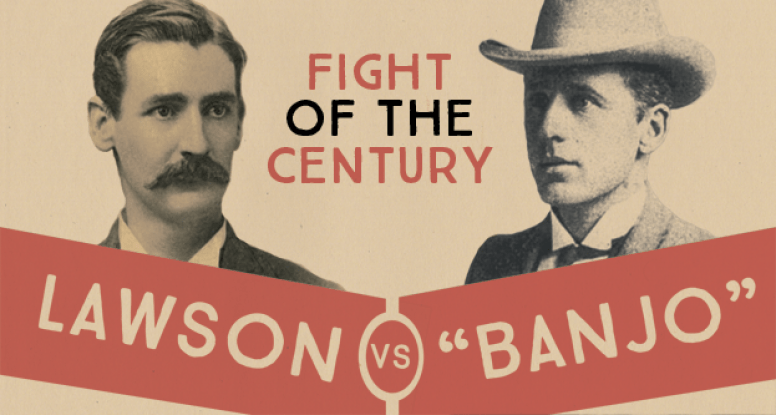
Fight of the Century Lawson vs “Banjo” Feels like a boxing match! In many ways it was, for Australia’s perception of itself
These influences and differences were on full display in what has been dubbed “The Bulletin Debate”. In 1892 there was an Australian magazine called the ‘The Bulletin’, which had built up a renown in local circles for budding poets and writers to disperse their works, often as part of a growing trend of nationalism which was termed the “Bulletin School”. Into these pages delved Lawson, with a scathing diatribe against the aggrandised representations of the Bush that frequented the national psyche:
…I am back from up the country, up the country where I went Seeking for the Southern poets’ land whereon to pitch my tent; I have shattered many idols out along the dusty track, Burnt a lot of fancy verses — and I’m glad that I am back. I believe the Southern poets’ dream will not be realised Till the plains are irrigated and the land is humanised. I intend to stay at present, as I said before, in town Drinking beer and lemon-squashes, taking baths and cooling down.
Henry Lawson Up the Country 1892
We can see Lawson’s use of metaphor and first person conveys
his desire to cut through the ‘fancy verses’ of his contemporaries to unveil
the true reality of the land in which they dwelt.
Banjo responded with ‘In Defence of the Bush’
…And the ‘shy selector children’ — were they better now or worse Than the little city urchins who would greet you with a curse? Is not such a life much better than the squalid street and square Where the fallen women flaunt it in the fierce electric glare, Wher the sempstress plies her needle till her eyes are sore and red In a filthy, dirty attic toiling on for daily bread? …
Banjo Paterson In Defense of the Bush 1892
Banjo’s evocative rhetoric summons to mind a drab urban hellscape,
which is sure to give any reader pause. Surely the bush must be better than
this?
Here we can see the classic conflict of city and country on
full display. What makes this dynamic intriguing is both are residents of the
city. One presents it as a haven of civilization amidst the untamed wild, the
other a banal urban misery. And when viewed in this lens, it’s as though their
role and mindset have suddenly swapped! Banjo is dourly lamenting the
surrounding environment whilst Lawson sings its praises. Both demean one
environment for the sake of the other.
We have some interesting insight into this debate from Banjo himself in his later years when he did an interview with the Sydney Morning Herald –
Henry Lawson was a man of remarkable insight in some things and of extraordinary simplicity in others. We were both looking for the same reef, if you get what I mean; but I had done my prospecting on horseback with my meals cooked for me, while Lawson has done his prospecting on foot and had had to cook for himself. Nobody realized this better than Lawson; and one day he suggested that we should write against each other, he putting the bush from his point of view, and I putting it from mine.
“We ought to do pretty well out of it,” he said, “we ought to be able to get in three or four sets of verses before they stop us.”
This suited me all right, for we were working on space, and the pay was very small . . . so we slam-banged away at each other for weeks and weeks; not until they stopped us, but until we ran out of material . . .
“Banjo Paterson Tells His Own Story”, Sydney Morning Herald, 4 Feb-4 Mar 1939
Perhaps a degree of cynical utilisation, but the essence of their debate is one that Australia was grappling heavily with at the time, and indeed arguably still is to this day. It’s fair to say that the more inspiring Banjo’s work stays in the popular conscious, but beneath the veneer lies a most ancient and harsh country that we would do well to pay a hearty volume of respect. Look no further than my first blog to consider that! Who do I side with more? The Drovers Wife and The Man from Snowy River, arguably their most renowned works, are in many ways different faces of the same coin. Looking in opposite directions and never to meet, but fused together by their time and place. In my view, there is plenty of room for both and more in this ‘wide brown land’.
Elder, Bruce (2008), “In Lawson’s tracks [The Henry
Lawson Trail from Bourke (NSW) to Hungerford (Qld). Paper in: Re-imagining
Australia. Schultz, Julianne (ed.).]”, Griffith Review (19):
95
Henry Lawson Up the
Country 1892
Banjo Paterson In
Defense of the Bush 1892
“Banjo Paterson Tells His Own Story”, Sydney Morning Herald, 4 Feb-4 Mar 1939
Welcome to my first blog entry! After having a browse of the suggested topics for discussion and letting them percolate in my brain for a while, I decided upon this prompt to ease into it –
CREATIVE– Which poem or story that we have looked at so far made an impression on you? What was the impression it made? Can you imitate the poem or story and create your own poem or story drawing on your own personal experience.
Whilst going through the readings for week 2 I found myself
enraptured by Xavier Herbert’s description of the sheer presence and power of
the land in Capricornia. I cannot
claim to have encountered the full fury of the onslaught of the wet season in
far northern Australia, but it was a vivid reminder of the last time I experienced
Nature’s full majesty in this ancient rugged country.
On the last day in 2018, New Year’s Eve, I found myself in
the Hunter Valley on my grandparent’s farmstead with my extended family, planning
to enjoy the Maitland fireworks. But nature had other plans for us and we ended
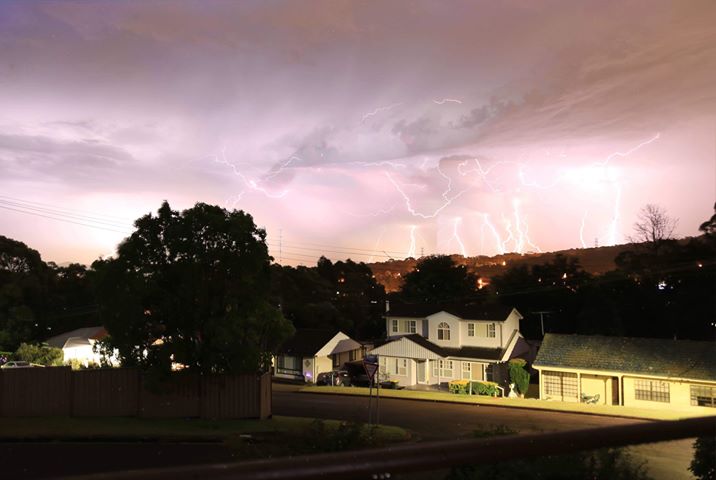
up watching some of the most impressive ‘fireworks’ I’ve seen:
Clothing danced frantically in the wind, their stilted, jerky motions a desperate plea for succour from the encroaching storm as the sky began to darken. Frantic arms plucked them from the line, haphazardly casting them into disparate piles, the cries of separated woollen twins stifled by the linen above.
And not a moment too soon! A hush fell over the land, as all was still and quiet. Save the soft call of the wind, growing louder and more strident as it heralded to the fury to come. A demure murmur sounded in the distance. It went from a whisper, to a mutter, to a gurgle, to a ponderous rumble, to a reverbing, thunderous roar, as the sky itself churned and convulsed, a sea forming in the realms above to descend upon the earth and bury it in the deluge. The Sun fled before their passage, dragging his light with him. As they drifted above, clouds delivered their payload as the bays were opened. With a hiss the droplets plunged, down, down, down to shatter and spatter on the land below, sluicing down in a thicket no eye could pierce. Ice ferociously pounded on metal, a sharp harsh pattern playing out a staccato tune on tin rooves.
Lightning descended, rapacious fingers greedily scrabbling to find the nearest purchase in the earth. Night became day, and for the briefest of moments all was cast in stark relief, elation mixed with trepidation etched on to each face. There was a thunderous crack, as though the very heavens were being breached. The land shook, as if from the awakening of some ancient, primal beast clambering free from its shackles, which triumphantly begun to roar, the rumble of its lungs reverberating over and over. With a whimper the feeble lines of electricity travelling on wires below shivered and died in its presence, the diminutive lights they breathed fading with them. The tang of ozone wafted in the air. And still the land was bright as day, the blinding white light extending and retracting with each of the beast’s calls as it coalesced above, majestic and petrifying in equal measure. Gathered to its full height, it gazed down upon the denizens gathered below. The beast roared with conviction, its voice crackling and thundering.
“Your fireworks are but sparks and sputters in the wind. Behold! I shall produce the grandest pyrotechnics you could ever hope to perceive.”
No one was inclined to dispute its claim…
“Thunder in the Hunter” I did a little digging and was able to find a picture someone had snapped for the local news. Impressive as it is, it does not do justice to being there and drinking in the power on display.
As a bit of shameless self-promotion, I contribute to another word press blog where we endlessly discuss Lord of the Rings and playing with toy soldiers. Check it out if the mere thought of that doesn’t immediately put you to sleep! https://greycompanyrangers.wordpress.com/category/middle-earth/

 Andrew Colman: Adventures in Literature