Peer Review #2

Hi Evelyn, the first thing I noticed was the header image, it’s simple yet powerful, very much in keeping with the Imagist mindset. The consistent questioning and the running theme that connects each stanza through their opening lines excels in keeping the poem cohesive. The short, sharp and direct lines are a strong choice for your subject matter as well. Thank you for being open and writing about the topic, as you say awareness is important.

To add some more context to your insightful analysis of the Imagists, some of their style served as a challenge to the work of the Romantic writers who preceded them, which I was fortunate enough to be able to study last semester in 19th Century Literature (I can see you were doing Shakespeare). Free verse was another heavy focus, I think their desire for directness and management of the ‘word economy’ is a great choice for the nature of what you have written about.
Blog #3: Nude In A Rocking Chair

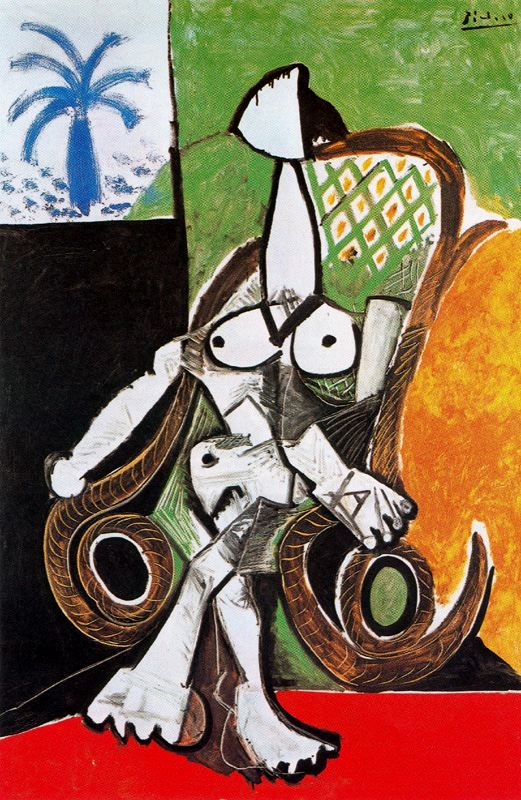
3/ Describe the Picasso painting above. In other words paint his picture IN WORDS. Say briefly what makes it “modernist”. Your piece, whether in poetry or prose, will be Ekphrastic writing!!

In the distance flashes the flicker of blue, a shadowed tree in a white oasis, an ephemeral mirage to match the scene unfolding within. The floor beneath runs in a red the shade of blood. Things fall apart, the centre cannot hold. The throne snakes and curls upon itself as it bears its awful burden. Upon her throne she reclines in freakish ease, faceless and yet not, as below the surface something has been revealed. The destructive form tears at the seams, warping and pulling in all directions, splayed and naked to the air. It squirms itself across her, a grotesque mark that swells out drooping across the skin, sagging yet swollen. Baleful eyes stare forth in wild mockery, bulging as they gaze upon a world transformed, or perhaps simply uncovered. Claws and clubs, a new facsimile for hands and feet, flail in a feeble attempt in to contain what lies below.  A gash opens as the mouth aggressively rears forth, spewing forth a wordless diatribe from a gaping maw where darkness beckons. A crude mockery spawned from the mind of a madman? Or perhaps one who sees more clearly than any who have before, going beyond the surface to what lies beneath.


When I first looked at the painting I saw a strange caricature of a face. My friends looked at it and laughed, then I read the title…Part of the concept of modernism is a reflection on destruction, change, transformation and purpose. Within art in particular, there was an interest in experimentation that this painting clearly demonstrates. I felt genuinely uncomfortable finding the right phrases to best describe the essence of this painting. The invasiveness of Picasso’s features over the form of Jacqueline Roque is quite provocative. In this description I’ve looked to incorporate phrases from other writers that we have examined this semester like Woolf and Yeats that share elements of this sentiment of modernism. Interestingly enough, it is currently part of the collection of the Art Gallery of NSW. I leave you with a commentary from their website:

By the time he painted this faceless female figure, Picasso was a towering legend of modern art. Yet to say she is faceless is not entirely accurate: across her torso, breasts, belly and pudenda the painter has inscribed the disconcerting semblance of his own features. Her nipples are the tell-tale black pupils of his eyes, her serrated vagina is his equally aggressive mouth. Having thus invaded her body, his own erupts in the manner of a physiological mutation. It is not an easy image, but it is wholly truthful to Picasso’s deepest intuitions and experience. Anger belies the innocuousness of the subject matter. Fear underscores the anger. It is only very marginally a work of art about appearances. Instead, Picasso enacts a form of black magic, an exorcising ritual of bodily destruction and psychic derangement that plays fast and loose with reality – all within the conventions of the seated portrait. That he did this through the agency of his last great love, Jacqueline Roque, setting her violated form in the serenity of his new villa at Cannes, is admirable and repulsive in equal measure. The gesticulating palm tree may well allude to Matisse, whose recent death reminded Picasso of the inescapability of mortality.

Art Gallery Handbook, 1999
https://www.artgallery.nsw.gov.au/collection/works/66.1981/?
Nude In A Rocking Chair 1956 Pablo Picasso

Peer Review #1

Charmaine, your focus on imagery has produced powerful results!

The bolded text and colloquialism is wonderfully effective in building the tone of desperation and destruction in the poem. The final line is particularly striking, the mundanity usually surrounding the context of something being stapled is a strong use of juxtaposition. The shifts in person are really interesting as well, lots of second person and confrontation for the reader.

As a history fan I’d like to share a small part of historical trivia that could make this piece even stronger. Land mines weren’t particularly prevalent in the First World War except to bring down heavily fortified positions through tunnelling or as a countermeasure for enemy tunnelers. They were far more common in the Second World War with the advent of mass produced tanks. Far more prevalent and destructive was the shelling caused by enemy bombardments for days on end. If you were inclined to extend this piece, I’m confident based on what you’ve written here you could produce a few lines on the way they made the earth tremble and your brain rattle inside your skull for days at a time, as if the heavens had cracked.

A great read, thank you for writing!

https://charmaineslitblog.wordpress.com/2020/08/21/77/

Blog #2: They Will Be Remembered

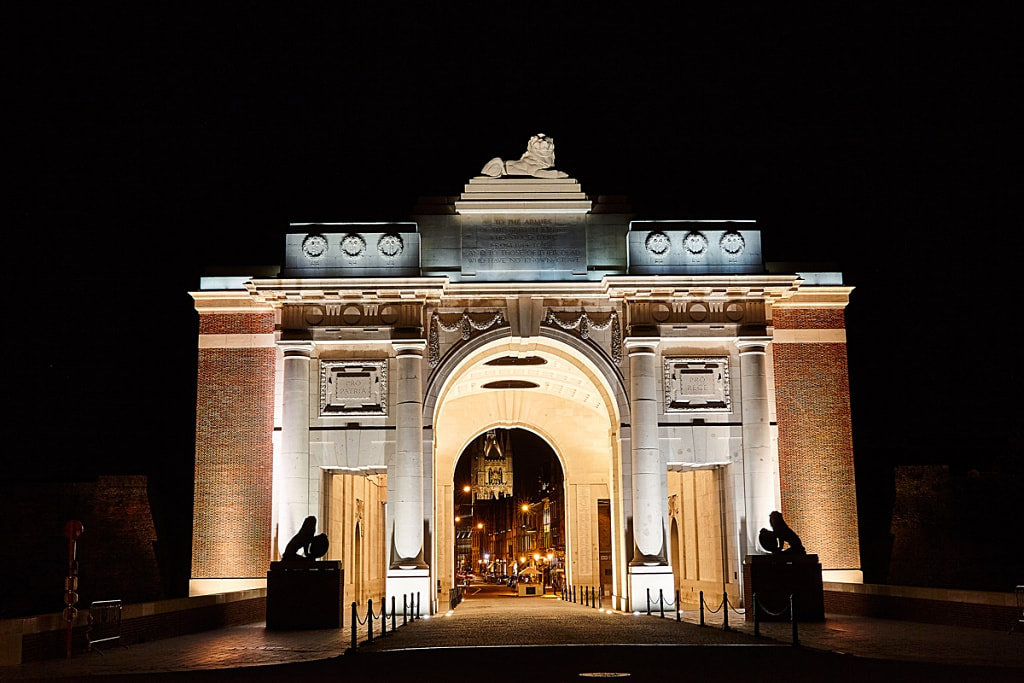
4/ CRITICAL How does your response to Sassoon’s “On Passing the New Menin Gate” make you reassess your reaction to war memorials in your own country? Try to be as honest as you can about this.

I was admittedly taken aback by Sassoon’s poem as it challenged my own understanding of war memorials. I visited my grandparents who live in a little town called Greta within the Hunter Valley last weekend. In the local cemetery I passed a memorial that commemorated those that had died in war. There were roughly 20 graves laid out for those that served in the World Wars. It was striking considering the size of the town in that time and was a powerful reminder for me, that carried into the examination of war poetry.

I would contend that memorials in the current time serve an important function of remembrance and possess a substantial educational purpose. The Australian War Memorial, for example, is a vital repository of Australian history (albeit one subject to debate as I will discuss later). It is important for posterity these events be commemorated visibly and publicly. In my experience they are for remembrance, not glorification. I did some research on the memorial in question and discovered the following:

At the opening ceremony in 1927, these words were spoken: ‘It was resolved that here at Ypres, where so many of the missing are known to have fallen, there should be erected a memorial worthy of them which should give expression to the nation’s gratitude for their sacrifice and their sympathy with those who mourned them. A memorial has been erected which, in its simple grandeur, fulfils this object, and now it can be said of each one in whose honour we are assembled here today: “He is not missing; he is here!” ‘

https://allpoetry.com/On-Passing-The-New-Menin-Gate

Traffic is halted and The Last Post is played daily at the memorial, which attracts a fair volume of local tourism. I would consider those to be highly positive outcomes. Such a strong visual reminder should (hopefully) discourage the repetition of such awful, meaningless tragedy, but I do understand his possible frustration at the lack of greater acknowledgement and true representation of the horrors of war. Impressive monuments can be a poor medium to convey the mud, blood and death of the trenches. He may also have taken issues with its scope in light of the fear that it glorifies war rather than serves a sobering reminder of its inevitable consequences. It is possible to interpret the line of ‘nation’s gratitude for their sacrifice’ as only a breath away from ‘Dulce decorum est pro patria mori.’

In a similar vein, the most recently proposed expansion to the Australian War Memorial has attracted criticism, being labelled ” a slipshod and arrogant exercise in public administration, a deeply flawed process … The work, the Memorial development, is unnecessary and has many objectionable features.” Part of the proposal is to demolish the design award winning Anzac Hall and replace much of the space with decommissioned vehicles and aircraft.

As one Australian war widow noted:

“Replacing it with a gigantic structure to display decommissioned military hardware and an F-111 fighter jet serves to distract and distance us from the understanding of commemorating and honouring our war dead. Bigger does not mean better, and more expensive does not buy broad commemoration”

https://www.abc.net.au/news/2020-07-15/australian-war-memorial-development-criticised-inquiry/12456226

When I consider that this is the same as the concerns that underpin Sassoon’s work, I become much more understanding of them. Remembrance cannot turn into worship or glorification.

Blog #1: Alliteration in Spring

Take the first line of any one of Hopkins’ poems and write your own poem celebrating the arrival of Spring in your part of the world. Try to incorporate some of Hopkins’s amazing experimentation with language texture especially with sounds.

Nothing is so beautiful as Spring –

Aganapanthus awakening affablly

Behold the Bell-flower beginning to bloom

Clovers creating a cacphony of colour

Dapper Dahlias deftly dancing

Eagerly extolled by enraptured Echinacea.

Foxgloves flaunting fabulous frocks

Germinating Geraniums gallivanting galore

Here the Hydrangea has its heyday.

Impeccable Irises idle

Jaunty Jasmines jostle

Kalmias kindle a kaleidoscope.

Lo the Lavender languidly lounges

Magnolias mesemerise magnificently

Narcissi nimbly form a nimbus

Orchids offer officious obeisance.

Perfect the Peony, pleasant and passionate

Querulous Quince quashed by the quota

Reticent Roses red and radiant

Salutary Snowdrops sanguinely sing.

Tentatively the tulip tries to take after

Unlike the Ursinia’s unprompted undertaking

Violet Violets vaunt their value

While the Wallflower wakes and waves

Xanthoceras’ xanthic, xiphoid xenia beckons.

Yonder the youthful yellow yarrow yawns

And Zenobia zips with zesty zeal.

Such is Spring, spreading semantic synergy with sanguine satisfaction.

With a challenge set to focus upon sound, I decided to experiment with my capacity for alliteration with an alphabetic rendition of the flowers of Spring. Admittedly they may not all be flowers of spring and some of the lines are clumsy and lack cohesion, but I am pleased to have at least attempted the idea and tested the depths of my vocabulary. There is a distinct satisfaction in having the lines roll off the tongue.

https://www.fiftyflowers.com/blog/wp-content/uploads/iStock-659171982-1170×449.jpg

Summative Entry

The Nineteenth Century gives me real insights into human and social issues that are still current in the 21st century.

The work of the Romantics alongside writers such as Dickens and Earnest has raised my awareness of the universality of the concerns they raise in society. Examining all of the blogs I’ve made this semester in hindsight there is a common thematic thread of freedom. Freedom of expression, of thought, of knowledge, of possibility. This incorporates the Romantic values of imagination and the openness of nature, Dicken’s repudiation of the narrow desire for facts and Earnest’s satire of a society of surfaces. What all these notions also share in one manner or another is the importance of Wordsworth ‘wise passivenesses’, of taking the time to be receptive to the world and what it has to offer you without being overwhelmed with the demands of society. Indeed all these principles are highly relevant to the present day and arguably so long is civilization they will continue to resonate with readers of their works.

In my first blog, https://adventuresinliterature.art.blog/2020/03/09/blog-1-pandaemonium/ a critical analysis of the film Pandaemonium, I explored this very question of the film’s relevance to the 21st century. I began with a series of comments on freedom throughout the world, both historically and today. Pertinent to this discussion was the constant bombardment of information we receive in the digital age, to disseminate knowledge on a scale hereto unimaginable, yet coming at the cost of mindfulness. As I discussed, distractions lurk in every corner.

This would subsequently serve as a direct inspiration for my second blog; https://adventuresinliterature.art.blog/2020/03/15/blog-2-the-sirens-call/ The Siren Call of technology. Taking the opening line of Wordsworth’s “The World is Too Much with Us”, I retained his use of pagan mythology and fears of a world detached from nature and transposed them to the modern day. I sought to poetically convey the constant lure of phones and social media and the thrall they hold upon 21st Century society, often to the detriment of our appreciation of each other and the world. Indeed, it attempts to do so as I write this!   

My third blog, a creative piece on a grandiose artwork depicting the visit of Queen Sheba from the NSW Art Gallery, was in many ways a reflections of the painter’s intentions, escapism. https://adventuresinliterature.art.blog/2020/04/05/blog-3-the-halls-of-the-forest-of-lebanon/ Just as the art sought to distract from the state of England at the time, which the writers in this unit have critiqued in one form or another, so I sought to take a momentary respite from its concerns. From a technical standpoint I enjoyed the process of writing this blog the most, as I feel my skills are most developed in descriptive prose writing.

The fourth blog I wrote on Dickens finished on an uplifting note. https://adventuresinliterature.art.blog/2020/04/22/blog-4-dickens-and-deficiencies/ I discovered that for all the fallibilities of Mr Gradgrind the fact-finder, he proved himself to be a decent person. This message is a positive and timely reminder for today’s world of the possibility for redemption. It is never too late to be humble and open to others. Likewise, the emphasis on the value of creative expression was personally appreciated.

Taking this course has made me more conscious of my technological dependence, the consequence of an industrialised, capitalist society.  Personally speaking, it also provided me with validation for my choice to pursue literature at a tertiary level. The level of importance this notion of creative expression is given throughout the entirety of this unit is evident in the course of my blogging this semester. The concerns of the 19th century find themselves conceptually reflected in the 21st century, indeed some to an even greater degree in an ever more connected and artificial world. In the current climate of isolation and worldwide pandemic, it is a timely reminder of what is truly significant in our world.

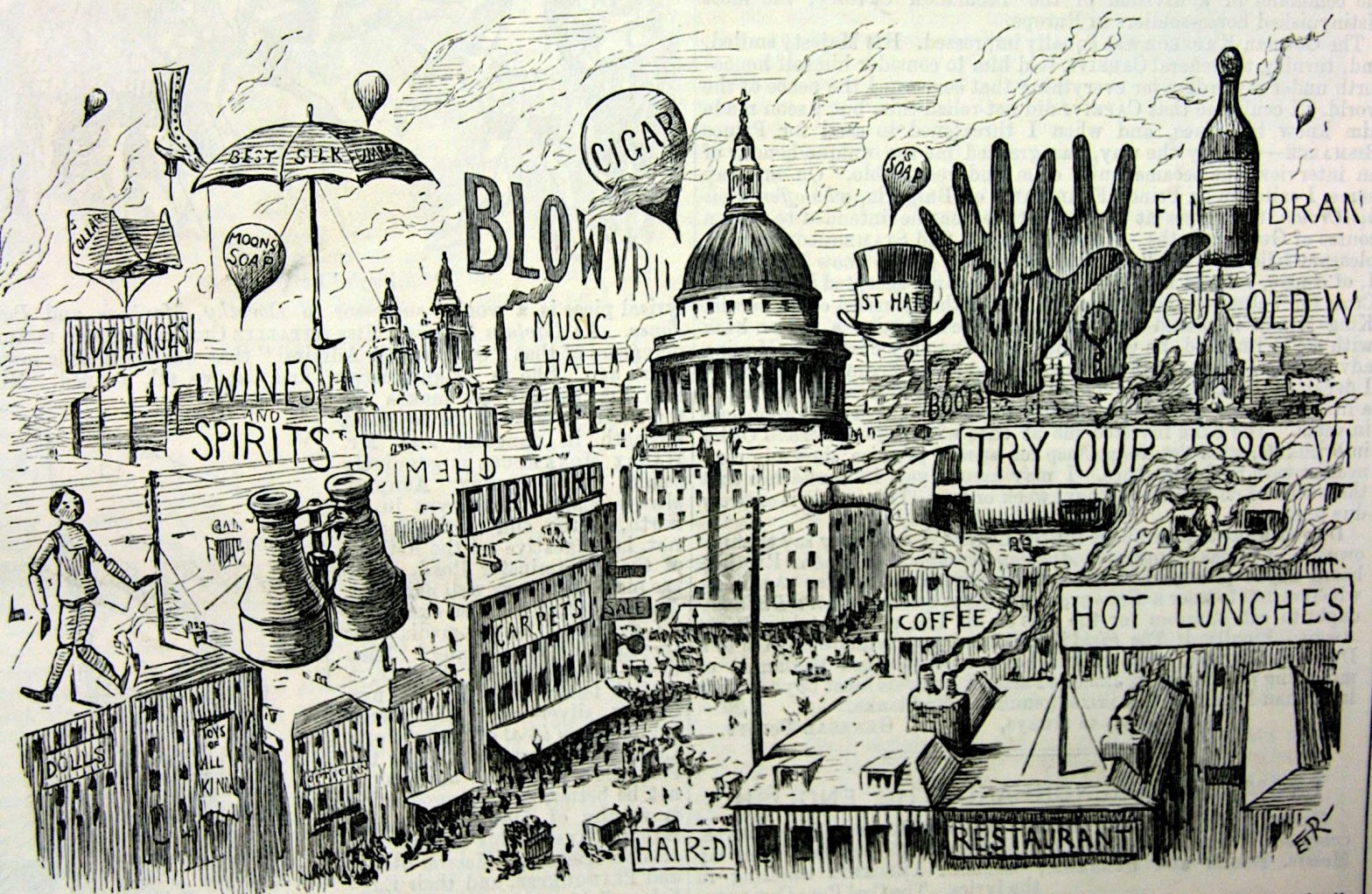
‘Picturesque London – or, sky-signs of the times’, Punch, 6 Sept 1890.

Peer Review #3

Caitlin, I enjoyed reading your insights into William Blake’s ‘The Garden of Love’, your technical analysis is impressive, I particularly enjoyed your discussion on symbolism. I can personally relate to the notion of growing restrictions moving into adulthood.  It is also interesting how there is this dichotomy between love and restriction in the context of this religious setting, when you’d think it would preach openness. It might be worth including line numbers in your quotes to assist someone who may wish to find those quotes in the broader context of the poem. Also, just be careful in the opening of your second last sentence, “This is theme is also” doesn’t quite make sense.

Blog #4 – Dickens and Deficiencies

2/ Write a letter to Charles Dickens commending him on how he has exposed real deficiencies in human behaviour.

Mr Dickens,

I must commend you on the powerful insights of your writing in Hard Times. Indeed, the deficiencies of human behaviour you expose could ironically even be termed as inhuman. Mr Bounderby’s snobbery and self-interest with his incessant reminiscing of the harshness of his childhood is used as a shield to dismiss the struggles of the workers in his factory. His fixation on capitalism and his status in society to the exclusion of all else comes at the cost of his relationship with his wife, viewing her as little more than property. The great irony that I enjoyed in his character having bought so heavily into Gradgrind’s mantra of “we want nothing but Facts sir; nothing but Facts” (Dickens 3) is the creative flair he possesses. He presents this entirely false vision of himself as a self-made man, surviving through a childhood of abandonment with self-drive and discipline; this requires no small quantity of imagination to maintain for years on end!

I was also touched by Mr Gradgrind’s transformation over the course of the novel as he comes to terms with the shortcomings of his outlook on the world. For all the rigidness of his approach and desire to avoid imagination and creativity, he demonstrates kindness on several occasions. He offers a home and an education for Sissy when her father abandons her, he supports Louisa in parting from Bounderby and he protects Tom from the law. He ultimately proves himself to be a decent person “making his facts and figures subservient to Faith, Hope, and Charity” (Dickens 233). I appreciate the powerful message you have laid into this work by not simply demonising those who adopt this rationalist approach, but demonstrating their capacity for redemption and that they are still human beings underneath that veneer. This positive outlook promises redemption for everyone mired in such a limited view of the world.

Dickens, Charles. Hard Times. Wordsworth Editions Limited, 2000.

MC, Jilly. “Mr Bounderby.” TES, 12 Oct. 2018, l.imgt.es/resource-preview-imgs/489b1d50-6b5e-4435-a532-99603d6fed93%2FBounderby.crop_530x397_0%2C62.preview.jpg?profile=res-img-med-legacy-v2.

Peer Review #2

George I really enjoyed your description of the Sydney streets, especially considering it is something that I’ve witnessed in person. Your use of detailed description is very reminiscent of Charles Dickens himself, your elongated final sentence is particularly evocative with the piling of comma after comma. Your word choice is very effective in creating that urban impression with ‘polyethylene’, ‘cement’, ‘synthetic’, ‘harsh artifice’. If you were to expand on this work as a larger piece of writing, I would think it would be good to correlate the white lights of the screens with the red, yellow and green of the traffic, there could be some strong symbolic links to make there. The downtrodden homeless of today could also feature, perhaps with some elements of Dickens and the circus.

https://georgiahoulihan.wordpress.com/2020/04/17/19th-century-literature-blog-post-3-charles-dickens-coketown-in-the-21st-century-creative/comment-page-1/?unapproved=28&moderation-hash=6282a6ca60e4b6c75777bcbe865ea474#comment-28

Blog #3: The Halls of the Forest of Lebanon

Ekphrastic writing: In words (either poetry or prose) vividly describe one of the paintings that you saw on our virtual tour of the gallery last week.

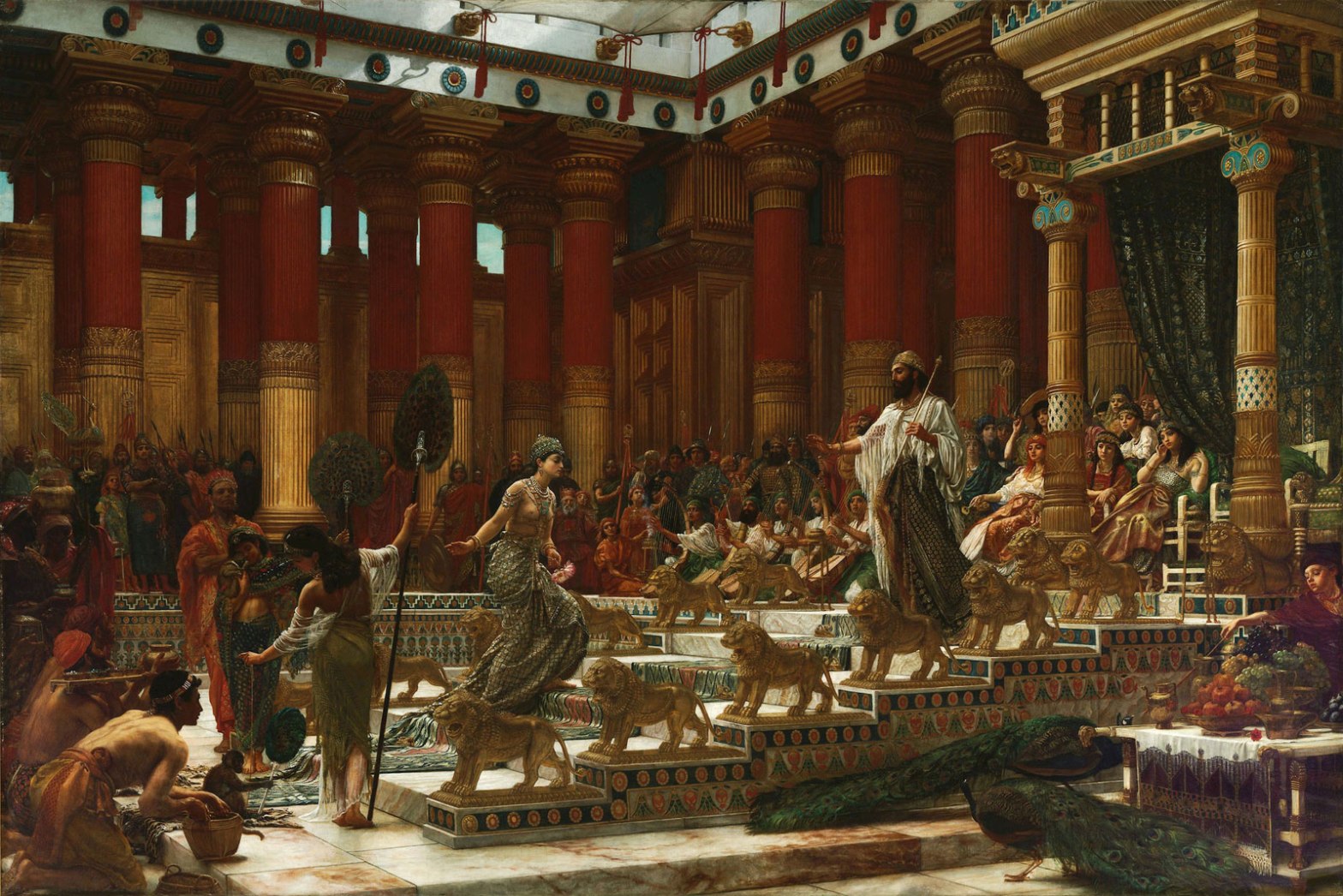
The vaunted halls lay open to the heavens, the sky a ceiling of sufficient magnitude to house such visions. Colossal trunks bore the skies weight, their roots slipping deep into the marble beneath, brilliant shades of red and gold. The marbled forest floor was smooth and cool to the touch, polished veins weaving their way through the rock, the pad of bare feet less than a whisper. Rich carpet cast a layer of litter to the forest floor, a soothing warmth from the soft marble. Two hundred shields clung to the pillars, each burnished with beaten gold that shone with a lustre to blind the eyes, sunlight to nourish the forest of stone and finery. Wine flowed like nourishing rain. Upon twelve silver steps lay one golden throne, encircled with ivory that had grown to embrace it. A pride of lions made their dwelt upon it, as peacocks strutted back and forth on the floor below, their grand plumage proudly vaunted. To such a place came all the kings of the Earth, to drink from pools of gold, sit upon chairs of cedar, to marvel at the denizens of such a dwelling, be garbed in raiment to make their own clothing little more than rags and grasp wisdom in their hands. Such was the Halls of the Forest of Lebanon.

Yet on this day the fierce lion stood stiffly at attention in every step, struck to stillness. The peacocks were drab, their feathers wan. The wine was soured in every cup, the lights of the shields were dimmed, the columns sagged, the carpet faded, the throne choked beneath the ivory. For a woman entered into the hall, and Solomon’s riches were nothing in the face of her presence. The Queen of Sheba had come, and the forest would be darkened forever after.

….

I elected to describe the visit of the Queen of Sheba to King Solomon, an incredibly grandiose and biblical piece. There is a section in the Old Testament that describes the incredible wealth of King Solomon and the extravagance of the Halls of the Forest of Lebanon that I used for inspiration (2 Chronicles 9:13-29). I can also see its influence upon Poynter in his painting as well in the opulence on display and even the marvelous frame the scene is placed.

The visit of the Queen of Sheba to King Solomon

Sir Edward John Poynter England 1890

Design a site like this with WordPress.com
Get started